Division of Endocrine Surgery
The Division of Endocrine Surgery at NYU Grossman School of Medicine is dedicated to providing the most comprehensive care to people who require surgery for a range of thyroid, parathyroid, and adrenal conditions. Our team conducts research that leads to new, advanced treatments for endocrine disorders. Our experienced team also trains tomorrow’s leaders in the field.
Endocrine Surgery Clinical Services
As leaders in innovating surgical techniques and procedures, our team often works in concert with colleagues at Perlmutter Cancer Center, providing treatments for thyroid, parathyroid, and adrenal conditions, including the following:
- thyroid nodules and cancer
- hyperparathyroidism
- parathyroid cancer
- hyperthyroidism and Graves’ disease
- multinodular goiter
- adrenal tumors, also known as adrenal nodules or adrenal masses
- primary aldosteronism, also known as Conn’s syndrome
- Cushing syndrome
- pheochromocytoma and paraganglioma
- adrenocortical cancer
- hereditary endocrine tumor syndromes
Our Faculty
Led by the director of the Division of Endocrine Surgery, Kepal N. Patel, MD, the division is one of the highest-volume endocrine surgery programs in the country. Research has shown that surgeons who perform a high volume of specialized surgical procedures have the best outcomes and lowest rates of surgical complications.
In addition, our faculty are national and international leaders in the field who shape the most current research and evidence-based guidelines in endocrine surgery.
Endocrine Surgery Research
We are engaged in a rich array of research projects addressing the important questions in endocrine surgery today. Some of the research areas and methods investigated by our faculty include the following:
- accuracy and utility of molecular testing of thyroid nodules and thyroid cancer
- development of the most advanced treatments for endocrine surgical conditions, such as scarless transoral thyroidectomy and radiofrequency ablation
- advanced imaging technologies for hyperparathyroidism
- cost-effectiveness analysis of current and upcoming treatments for endocrine surgical conditions
- novel methods for analyzing big data, such as machine learning, to improve prediction of clinical outcomes in endocrine surgery
- improving screening and detection strategies for endocrine conditions in the general population
Learn more about research in our division.
Our Commitment to Innovation and Safety
As innovators in the field, members of our division develop and incorporate leading-edge technologies into the care we provide for our patients, with the ultimate goal of maintaining their safety and improving their wellbeing.
Molecular Testing for Thyroid Nodules
The incidence of thyroid cancer is increasing more rapidly than any other cancer in the United States, with an estimated 44,280 cases in 2021. Although most thyroid nodules are benign, current guidelines recommend fine-needle aspiration (FNA) biopsy of most nodules, particularly those larger than 1 or 1.5 cm.
Thyroid nodules that are biopsied as inconclusive have typically required thyroid surgery for definitive diagnosis. Up to 80 percent of patients who have inconclusive biopsies do not have thyroid cancer.
Our division is the largest institution in New York to offer advanced molecular testing for thyroid nodules. This type of testing allows surgeons to determine which patients with inconclusive thyroid FNA are candidates for surgery and to assist in planning the extent of surgery. Our goal is to provide appropriate, expert, individualized care for all patients with thyroid nodules.
Minimally Invasive Adrenalectomy
Our experienced endocrine surgeons work closely with specialized endocrinologists, radiologists, and pathologists to provide appropriate, safe, and effective care for people who have surgical conditions of the adrenal glands.
Minimally invasive adrenalectomy using tiny incisions around the abdomen and flank has become the standard of care for most patients who have adrenal tumors and is a safe and extremely well-tolerated procedure. Most patients are able to go home within one to two days after surgery and recover quickly. The number of adrenal surgeries performed by our division is among the highest in the nation.
“Scarless” Transoral Endoscopic Thyroid and Parathyroid Surgery
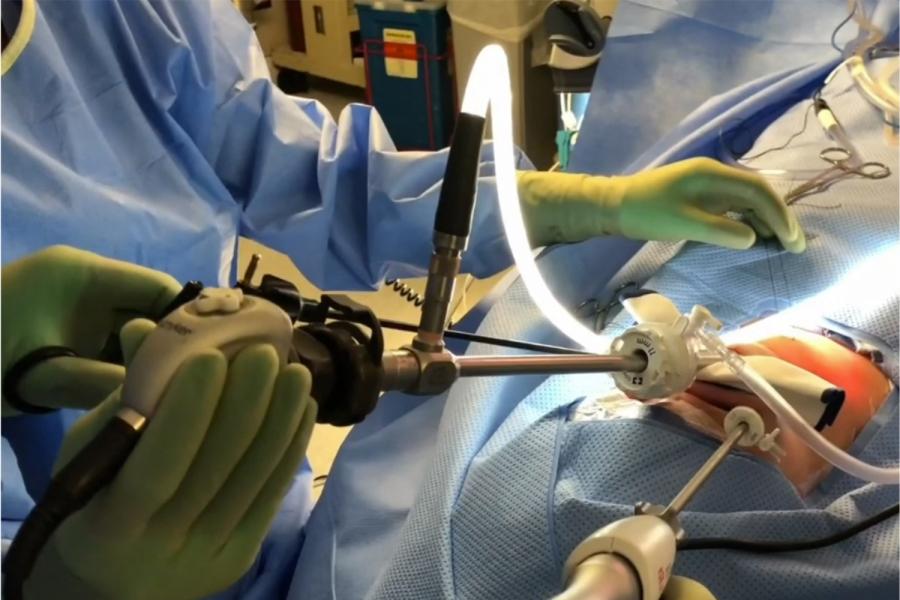
For some patients, thyroid and parathyroid surgery can be performed without a visible scar on the neck, by using tiny endoscopic incisions placed behind the lower lip inside the mouth. This technique has been demonstrated to be a safe, well-tolerated, and attractive option for many patients. As an internationally recognized expert and one of the first surgeons to pioneer this technique in the United States, Dr. Insoo Suh leads our scarless thyroid and parathyroid surgery program.
Intraoperative Recurrent Laryngeal Nerve Monitoring
The recurrent laryngeal nerve (RLN) is located in the lower neck, directly behind the thyroid gland. An injury to this nerve during thyroid surgery can result in hoarseness. When thyroid surgery is performed by experienced surgeons, this complication is very rare.
To further decrease the risk of hoarseness, our surgeons routinely monitor the RLN of patients receiving thyroid and parathyroid surgery. We use special monitoring electrodes that enable us to continuously assess the identity and function of the RLN as surgery progresses. The availability of this advanced technique reflects our commitment to patient safety and minimizing the risks of surgery.
Radiofrequency Ablation of Thyroid Nodules
Some benign thyroid nodules can be treated nonsurgically with radiofrequency ablation (RFA). This technology, in which a thin needle electrode is inserted into the nodule through the skin under ultrasound guidance, uses heat to ablate or destroy the thyroid nodule from the inside. This technique is a safe and effective alternative to surgery for carefully selected indications and requires thorough evaluation and discussion to ensure that it is utilized safely and appropriately.
Endocrine Surgery Education
We are dedicated to developing new clinical programs and educating surgical residents in the rapidly growing subspecialty of general surgery. NYU Grossman School of Medicine’s two general surgery residencies, one in Manhattan and the other at NYU Langone Hospital—Brooklyn, are among the most prestigious in the country. Residents receive training from our faculty, enabling them to incorporate advances in endocrine surgery into their own surgical practices. In addition, our faculty and trainees have access to our robust databases and tumor registries.
NYU Grossman School of Medicine students may choose to spend a four-week rotation in the Division of Endocrine Surgery through the Endocrine Surgery and Surgical Oncology Selective.